
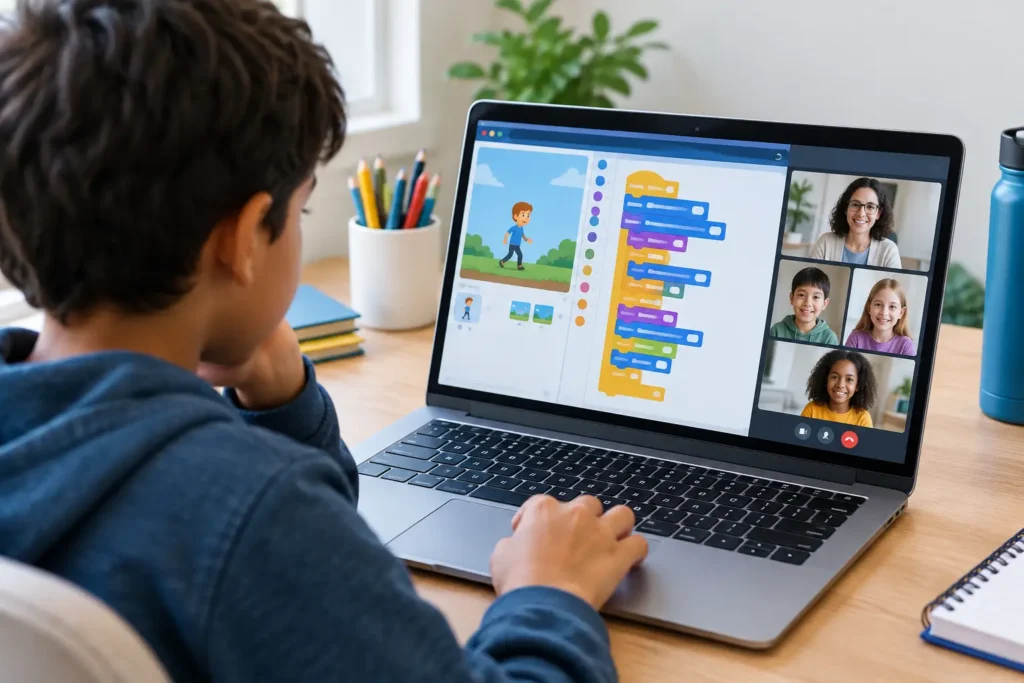
A student asks an AI tool to make a game, and a working version appears in seconds. For parents, that moment raises a reasonable question: are coding skills still vital? If technology can write code, is learning to code still worth a child’s limited after-school time?
Yes — coding skills are still vital, but the reason has changed. Coding is no longer valuable simply because every student must memorize programming commands. Its greater value is that it teaches children how to break down a problem, test an idea, spot an error, and improve a solution. Those habits support success in math, science, school, and a workplace where technology will be part of nearly every field.
Why Coding Skills Still Matter in an AI-Assisted World
AI can produce code quickly, but it cannot reliably decide what a young learner is trying to create, whether the result is correct, or whether the logic behind it makes sense. A student who understands basic coding skills can ask better questions, recognize weak answers, and make thoughtful changes. A student who only copies an AI-generated answer may have a finished product without having learned much from it.
This distinction matters well beyond future software careers. Doctors work with data systems. Engineers model physical systems. Scientists organize and analyze evidence. Entrepreneurs use digital tools to test ideas and communicate with customers. Even careers that are not traditionally technical increasingly require people to understand how technology shapes decisions.
Coding gives students a practical way to develop that understanding. They learn that computers follow instructions precisely, that small mistakes can change an outcome, and that persistence is often more useful than guessing. These coding skills show up as academic habits parents can see in other subjects, especially mathematics. The CSTA K-12 Computer Science Standards describe this same progression: understanding and reasoning come first, syntax follows.
Are Coding Skills Still Vital If Your Child Will Not Become a Programmer?
They can be, although the right depth depends on the child’s age, interests, and academic goals. Not every student needs advanced programming or a computer science major. But most students benefit from learning foundational computational thinking.
What Computational Thinking Actually Looks Like
Computational thinking means approaching a complicated task in manageable parts. A child might identify a pattern, create a sequence of steps, use a rule repeatedly, and check the result. That process closely connects to mathematical reasoning — in fact, it overlaps directly with the Common Core Standards for Mathematical Practice, which ask students to make sense of problems, persevere, and attend to precision. When students write a simple program to draw a shape, animate an object, or calculate a score, abstract ideas become visible.
For example, an elementary student using block-based coding may learn that a character moves only when instructions are ordered correctly. Free environments such as Scratch, developed at MIT, are built around exactly this idea. A middle school student can use variables to track points in a game, connecting the activity to algebraic thinking. A high school student might build a simulation, organize data, or write a program that applies a mathematical formula repeatedly.
The purpose is not to rush every child toward professional-level programming. It is to help them become comfortable with logic, structure, and revision. Those skills remain valuable whether a student later chooses engineering, medicine, design, business, research, or another path entirely.
How Coding Skills Build Math Confidence
Many parents think of coding and math as separate enrichment options. In practice, they often reinforce each other. Math gives students the language of patterns, quantities, relationships, and logical proof — the kind of reasoning the National Council of Teachers of Mathematics places at the center of good instruction. Coding gives them a hands-on environment in which to apply those ideas.
A program may fail because a student used the wrong operation, misunderstood a coordinate, or wrote conditions in the wrong order. Debugging that program asks the student to slow down and reason carefully: What did I expect to happen? What actually happened? Which step caused the difference?
That is a productive form of struggle. Instead of treating an error as evidence that they are “not a math person,” students learn that errors offer information. They can isolate the issue, revise one step, and try again. Over time, this builds confidence because progress is observable.
Coding does not replace a strong math foundation. A child who is still developing number sense, multiplication fluency, fractions, or algebraic reasoning needs direct instruction and practice in those areas, whether that comes from class work or targeted drill on a platform like IXL. However, well-matched coding skills practice can make math feel more purposeful and help students see why precision matters.
What Coding Instruction Should Look Like at Different Ages
The best coding experience is not the same for every K-12 student. Age-appropriate instruction keeps the focus on understanding rather than speed, and it keeps coding skills tied to what a child is already learning in math class.
Early Elementary: Build Sequencing and Confidence
Young learners build their first coding skills through visual, block-based activities that reduce typing demands. They can practice sequencing, directional language, loops, and simple cause-and-effect relationships. At this stage, a supportive instructor should encourage students to explain their thinking aloud and celebrate revision, not just a completed project. The beginner courses on Code.org are a reasonable low-pressure way to see whether your child enjoys this kind of thinking.
Upper Elementary and Middle School: Connect Logic to Real Projects
As students become more comfortable with multiplication, fractions, coordinates, and variables, coding skills can become more expressive. They may create interactive stories, games, animations, or simple models. Projects are motivating, but they should still include clear skill goals: using conditions, tracking values, recognizing patterns, and testing code systematically. Khan Academy’s computer programming courses show the kind of structured, concept-first sequence worth looking for.
High School: Choose Depth With Purpose
For older students, the question is less about whether coding skills are useful and more about what level serves their goals. A student considering computer science, engineering, data science, or certain research fields may need formal programming experience and deeper study of algorithms — AP Computer Science Principles is one common entry point. Another student may benefit most from a practical introductory course that develops digital fluency without crowding out essential math coursework, test preparation, or other commitments.
Coding Skills by Grade Band: What to Look For
| Grade band | Typical focus | Sign it is working | Math connection | |—|—|—|—| | K–2 | Sequencing, loops, direction | Child explains the order of steps aloud | Counting, patterns, left/right | | 3–5 | Conditions, variables, simple projects | Child predicts what the program will do before running it | Coordinates, operations, fractions | | 6–8 | Logic, data, structured projects | Child debugs independently instead of restarting | Algebraic thinking, ratios | | 9–12 | Algorithms, data structures, purposeful depth | Child can justify why one approach is better | Functions, modeling, statistics |
What AI Changes About Coding Skills, and What It Does Not
AI changes how students should learn coding skills. It does not eliminate the need to learn. In fact, it makes conceptual understanding more important.
Using AI as a Learning Assistant, Not an Answer Machine
Students should know how to use AI as a learning assistant rather than an answer machine. A helpful approach is to have a child first describe the problem, predict what a program should do, and attempt part of the solution. They can then use AI to ask for an explanation, compare approaches, or identify a possible error. Finally, they should test the code and explain why the revised version works.
Parents do not need to monitor every line of code. They can ask a few simple questions: What does this part tell the computer to do? What problem did you run into? How did you decide your solution was correct? If a child can explain the reasoning in age-appropriate language, the learning is likely real.
There is also a trade-off to consider. AI-generated code can move faster than a student’s understanding, which may create frustration or overconfidence. The goal is not the most polished app or game. The goal is for the student to gain ownership of the ideas behind it.
Choosing a Coding Program That Builds Real Coding Skills
A strong coding program should provide more than entertaining projects or passive video lessons. Look for live instruction, opportunities for students to ask questions, and a small enough class for an instructor to notice when a child is confused or ready for more challenge. Because the classes are online, the practical question is not how close a center is, but how well the instructor can see and respond to your child in real time.
Placement matters here, too. A beginner should not feel behind because classmates already know programming vocabulary, while an experienced student should not spend weeks repeating concepts they have mastered. Appropriate grouping helps students take meaningful risks without becoming discouraged.
Parents should also be able to see evidence of progress. That might include completed concepts, project feedback, homework, quiz results, or an instructor’s observations about problem-solving habits. At Avatar Learning Center, the same principle guides live small-group learning: students benefit when instruction is matched to their level and families have a clear view of growth.
A Useful Skill, Not a Race
Coding is worth learning because it helps students think with clarity in a technology-rich environment. Still, it should not become another source of pressure. A child does not need to start at age five, earn every certificate, or turn every hobby into a career plan. If your child is drawn to puzzle-style reasoning, a problem-solving program such as MOEMS may serve the same thinking goals better than a second coding class.
The most valuable next step is often a manageable one: a course that matches your child’s current math readiness, interests, and schedule, with an instructor who can make mistakes feel like part of learning. When students learn to reason through a problem instead of fearing it, they gain a skill that reaches far beyond the screen.
Frequently Asked Questions
Is coding still worth learning for kids if AI can write code?
Yes. Strong coding skills are what let a student judge whether AI output is right. A child who can read a program, predict what it does, and find the broken step gets real value from AI tools. A child who cannot is only collecting finished files.
At what age should my child start coding?
There is no required starting age. Many students do well beginning with block-based activities in early elementary, while others start in middle or high school and progress quickly because their math reasoning is already stronger. Readiness matters more than age.
Does coding actually help with math?
It supports math, but it does not replace it. Coding gives students a place to apply operations, coordinates, variables, and logical conditions, and debugging builds tolerance for productive struggle. A child who is behind in fractions or number sense still needs direct math instruction.
Will AI replace programmers before my child graduates?
Nobody can honestly predict that, and you should be skeptical of anyone who claims a firm number. What is clearer is that the reasoning underneath coding — defining a problem, checking a result, revising a solution — is useful across many fields, whether or not your child writes code for a living.
How much time per week does a child need to make progress?
One consistent live class plus modest practice is usually more effective than long, irregular sessions. Steady weekly contact gives an instructor enough signal to adjust pacing before a student gets stuck or bored.
Finding the Right Fit for Your Child
The honest first question is not “which course should we buy,” but “where is my child right now.” A short placement assessment tells you whether a coding class is the right next step, or whether shoring up math readiness first would make that class far more productive. If you would like help sorting that out for your child’s grade and goals, that conversation is the place to start.