

Math skills in the age of AI matter more, not less. AI can calculate and can even write out the steps, but it cannot tell your child whether an answer makes sense, which question is worth asking, or what to do when a problem is new. Those are the skills math builds, year after year, and they are the ones employers say they need most.
Many parents are asking a fair question. If a phone can solve an equation from a photo, why should a child spend years learning to do it by hand? It sounds a little like asking why anyone should learn to read when a phone can read aloud.
The answer is that the calculation was never the point. School math uses calculation to teach something bigger: how to think through a problem you have not seen before. That kind of thinking is exactly what a world full of AI tools rewards.
What AI Does Well, and What It Leaves to Us
AI tools are fast and often impressive. They are also sometimes wrong, and when they are wrong they sound just as confident as when they are right. Someone has to notice. That someone needs to understand the math.
| AI can | Your child still needs to |
|---|---|
| Compute quickly | Estimate first, so a wrong result stands out |
| Show the steps of a solution | Understand why each step is allowed |
| Answer the question it is given | Decide which question is worth asking |
| Repeat familiar methods | Find a way into a problem that is new |
| Produce an answer that sounds certain | Check it and explain it to someone else |
We have been here before. Calculators did not make number sense useless. They made it more valuable, because a person with good number sense catches the slipped decimal point and a person without it does not.
A Simple Example: Checking an AI Answer
Here is what math skills in the age of AI look like in practice. Suppose your child asks a tool for the price of an $80 jacket that is 25% off, with 10% sales tax added. A student with solid math skills does a quick check before trusting the reply. A quarter of $80 is $20, so the sale price is $60. Ten percent of $60 is $6. The answer should be $66.
If the tool says $66, good. If it says $60 or $68, your child knows at once that something went wrong, and can even work out what: the tax was left out, or the two percentages were simply combined.
That 20-second check uses fractions, percent and estimation, which is math from about grade 6. It is also the habit a careful adult uses at work with a spreadsheet or an AI assistant.
4 Reasons Math Skills in the Age of AI Matter More
You Need Math to Judge an Answer
A student who knows that 48 × 52 is close to 2,500 will question a tool that says 24,960. A student who understands percent will notice when a “50% increase followed by a 50% decrease” does not return to the start. Without that understanding, every answer looks equally believable. With it, your child stays in charge of the tool.
Math Is Practice in Reasoning
Every multi-step problem asks a student to read carefully, decide what matters, choose a method, carry it out and check the result. Do that a few thousand times between kindergarten and grade 12 and it becomes a habit of mind. That habit is what transfers to science, writing, coding and everyday decisions. We wrote about this in why asking “why?” is the most powerful way for kids to learn math.
AI Is Made of Math
The systems behind AI run on algebra, probability, statistics and calculus. The people who design them, test them and decide how they are used all rely on those subjects. A child who wants to build with AI, and not only use it, will need a strong math path through high school. Our article on whether coding skills are still vital looks at the same question from the coding side.
Employers Are Asking for Thinking Skills
In the World Economic Forum’s Future of Jobs Report 2025, analytical thinking is the most sought-after core skill: seven out of ten companies surveyed call it essential. As routine work is automated, the work that remains is the part that needs judgment. Math is where children practice judgment with clear right and wrong answers to learn from.
AI can give your child an answer. Only understanding lets them know if it is a good one.
Math Skills by Age: What to Build, and When
The thinking skills that matter in the age of AI are built in a clear order. Here is what to look for at each stage.
| Grades | Math skills to build | The habit behind them |
|---|---|---|
| K to 2 | Number sense: counting, comparing, adding and subtracting with understanding | Answering “How do you know?” |
| 3 to 5 | Multiplication, division and fractions; word problems with more than one step | Estimating before calculating |
| 6 to 8 | Ratios, percent, negative numbers and equations | Explaining why a method works |
| 9 to 12 | Algebra, functions, geometry, statistics and probability | Building a model of a real situation and testing it |
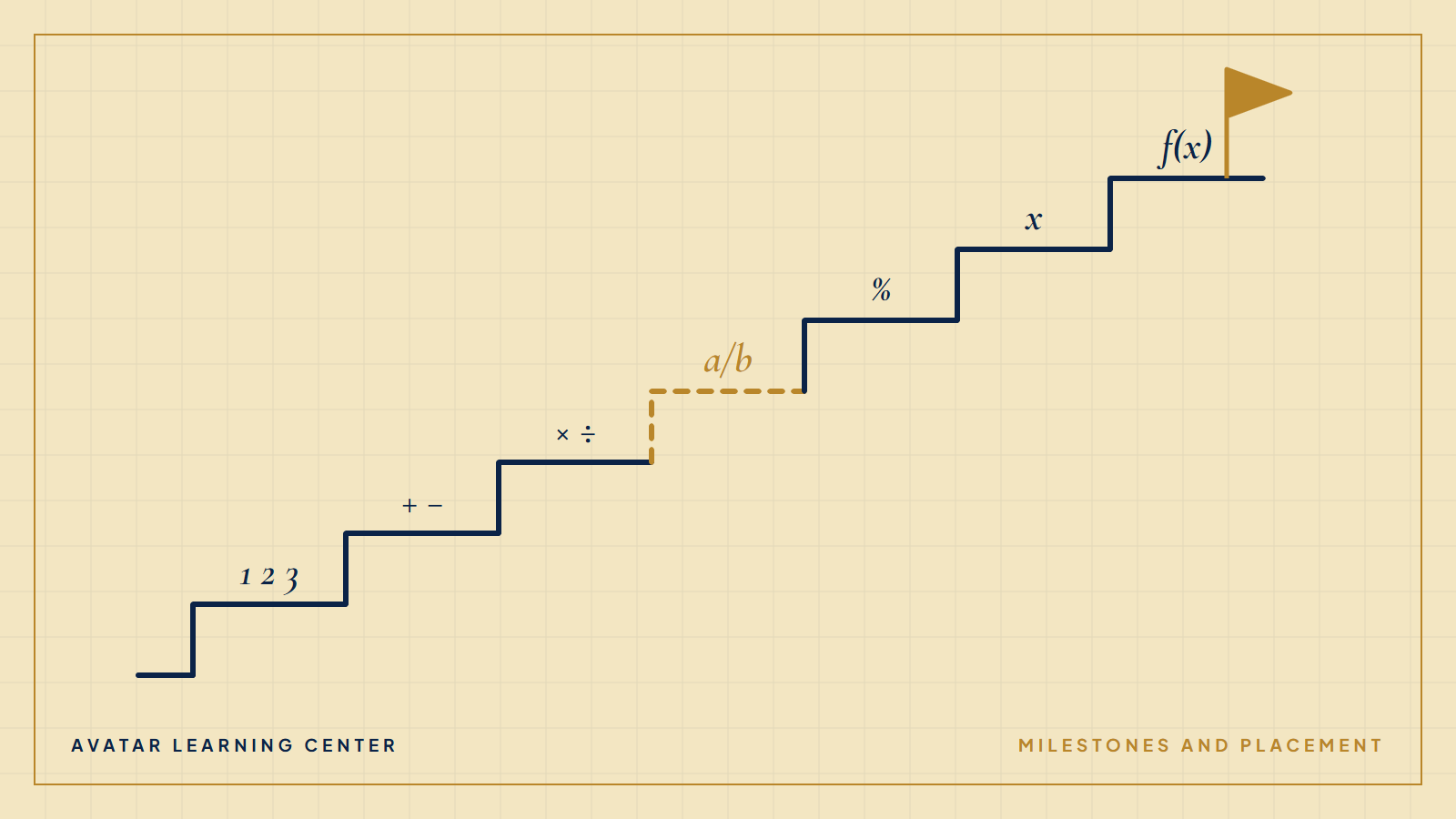
No stage can be skipped. A student who is unsure of fractions will struggle with percent, and a student who is unsure of percent cannot check the jacket example above. This is why a gap is worth finding early, at any age.
What This Means for Your Child’s Math Skills Now
The skills that matter most cannot be picked up in a weekend. Number sense in grade 3 becomes fractions in grade 5, which become equations in grade 8 and functions in grade 10. Each year rests on the one before. That is why steady progress through every school year matters more than any single test. Our kindergarten to pre-calculus pathway guide shows how the years connect.
A few habits at home support this kind of learning:
- Estimate before calculating. Ask “about how much should it be?” before the exact answer.
- Ask for the reason. “How do you know?” is worth more than “Is it right?”
- Let your child struggle a little. Working through a hard problem builds more than being shown the solution.
- Treat AI as a tutor, not an answer key. Asking a tool to explain a step can help. Copying its answer teaches nothing.
- Keep the practice steady. A little math every week, all year, beats a rush before exams.
How Avatar Teaches Math as Thinking
This is the kind of math we teach at Avatar Learning Center. Our Math Academic Year Program runs for 34 weeks, from September to June, for Kindergarten through Pre-Calculus. It is built so that understanding grows week after week:
- Live classes in small groups. Usually 5 to 6 students and never more than 8, so every child explains their thinking out loud.
- Three levels in every grade. One for catching up, one for keeping up, one for getting ahead. A free placement assessment chooses the level.
- The same teacher all year. Most of our instructors hold a PhD or a master’s degree.
- Homework checked the moment it is submitted. A wrong answer is caught the same evening, and your child tries again.
- A parent portal. You see attendance, homework and quiz scores as the year goes on.
Families can join at any time of the year; the course picks up at the right point. See the Math Academic Year Program for the plans.
Questions Parents Ask About Math and AI
Will AI make math skills unnecessary?
No. AI handles calculation, but people still have to set up the problem, judge the result and decide what to do with it. Those steps depend on understanding math.
Does my child still need to memorize math facts?
Yes. Quick recall of basic facts frees the mind for harder thinking, and it is what lets a student estimate and spot a wrong answer.
Which math skills matter most for the future?
Number sense, proportional reasoning, algebra, and later statistics and probability. Just as important are the habits behind them: reasoning step by step, checking work and explaining an answer.
Should my child use AI for homework?
It can help when it is used to explain an idea after your child has tried the problem. It does not help when it replaces the thinking. We will cover this in a separate guide.
At what age should children start building these math skills?
From the first years of school. Number sense in kindergarten is the base for fractions, and fractions are the base for algebra. It is also never too late: a missing skill can be rebuilt at any age once it is found.
Can AI teach my child math?
AI tools can explain a step or offer extra practice. They do not notice what a particular child has misunderstood, and they do not keep a child working steadily week after week. A teacher who knows the child does both.
Build Math Skills That Last
Avatar Learning Center teaches math in live online classes all school year, in small groups of up to 8 students, with the same teacher from the first week to the last. A free placement assessment shows where your child stands today: thirty minutes online with one of our educators.