
MOEMS Contest 2026‑2027The Complete Parent Guide to Getting Started, Key Dates, and Smart Prep
The MOEMS contest (Math Olympiads for Elementary and Middle Schools) is a five-contest season of challenging, non-routine math problems for students in grades 4 through 8. Each contest has five problems, and the 2026‑2027 season runs from November 2026 through March 2027. The best preparation is steady weekly problem solving, careful review of every missed problem, and gradual timed practice, not last-minute cramming.
A student does not need to be the fastest calculator in class to do well in MOEMS. Getting started is mostly about learning to slow down, notice patterns, and keep working when the first approach does not work. Those are skills students can build with the right practice and encouragement.
Avatar Learning Center has already held Contest 1 of the 2026‑2027 MOEMS contest season with our students, and four more are on the way, with the final contest in March. Whether your child is a first-time competitor or a returning one, this guide covers what the contest is, the season dates, how awards work, and how to prepare between each round.
For a deeper look at how a structured class builds skills over time, see our earlier article on MOEMS prep classes and how they build real math skills and confidence.
What Is the MOEMS Contest?
MOEMS stands for Math Olympiads for Elementary and Middle Schools. According to the official MOEMS program page, it is a nonprofit organization established in 1979, and more than 120,000 students from every U.S. state and dozens of other countries take part each year.
For many families, a math competition can sound intimidating. The questions look different from routine school assignments, time is limited, and students may worry that everyone else already knows special tricks. A better starting point is to view the MOEMS contest as structured problem-solving practice. It gives students a meaningful challenge while helping them become more flexible, confident mathematical thinkers.
What the MOEMS Contest Asks Students to Do
The MOEMS contest is designed to introduce students to non-routine math problems. Rather than asking students to repeat a recently taught procedure, problems may combine familiar skills in an unfamiliar way. A question about fractions might also require logical reasoning. A geometry question may depend more on spotting a relationship than on recalling a formula.
That difference matters. A student who earns strong grades in math may still need time to adjust to competition problems. Conversely, a student who is not always the quickest in class may thrive once they learn that persistence and strategy count as much as speed. This is the kind of thinking described in the Common Core Standards for Mathematical Practice, which ask students to “make sense of problems and persevere in solving them.”
Division E and Division M
MOEMS offers two divisions, so students compete against others at a similar stage:
| Division | Grades | Best fit for |
|---|---|---|
| Division E (Elementary) | Grades 4‑6 | Students building early problem-solving habits |
| Division M (Middle School) | Grades 6‑8 | Students ready for more advanced, multi-step reasoning |
Sixth graders can fall into either division. If your sixth grader is new to contest math, Division E is often a gentler start. If they already enjoy challenge problems, Division M may be the better stretch.
The 2026‑2027 MOEMS Contest Season at a Glance
The season is built around five monthly contests. Each MOEMS contest round has a testing window, and the group your child competes with picks a date inside that window. MOEMS asks that all students in a group take each contest on the same day at the same time.
| Contest | Testing window | Status at Avatar |
|---|---|---|
| Contest 1 | November 9 – November 30, 2026 | Completed |
| Contest 2 | December 7 – December 28, 2026 | Coming up |
| Contest 3 | January 4 – January 25, 2027 | Coming up |
| Contest 4 | February 1 – February 22, 2027 | Coming up |
| Contest 5 | March 1 – March 29, 2027 | Final contest |
All scores must be entered by March 31, 2027. These dates come from the MOEMS website. Always confirm your exact contest day with your school or program coordinator, since each team chooses its own date within the window.
How the MOEMS Contest Is Scored and Awarded
Each MOEMS contest has five problems, so a student who completes the full season attempts 25 problems in total. MOEMS provides detailed solutions after each contest, which turns every round into a learning opportunity, not just a score.
Individual Awards
Based on the official program page, individual recognition includes:
| Award | Who earns it |
|---|---|
| Certificate | Every participating student |
| Award patch | Top 50% of students |
| Silver pin | Top 3‑10% |
| Gold pin | Top 2% |
| George Lenchner Medallion | A perfect score |
| Highest individual scorer medal | The top scorer on each team |
Team Awards
Schools and other eligible groups can also earn team plaques (top 10%) and team certificates (top 11‑20%). Teams can include up to 35 students. MOEMS states that institute teams are not eligible for team awards, so students competing through a learning center are recognized through their individual awards.
Because results build across all five contests, consistency matters more than one great day. A student who steadily improves from November to March often ends the season with a result they are genuinely proud of.
Is My Child Ready for the MOEMS Contest?
A productive first question is not, “Can my child win an award?” It is, “Will this experience stretch my child in a healthy way?” Most students are ready to try the MOEMS contest when they have reliable number sense, can work independently for short periods, and are willing to discuss mistakes without shutting down.
Students do not need advanced algebra to begin. Middle schoolers do need comfort with core topics such as fractions, decimals, percent, ratios, basic geometry, and positive and negative numbers. More importantly, they need a foundation in reasoning. Can they identify what a question is asking? Can they organize information? Can they try a second method when the first method fails?
If foundational skills are still shaky, competition practice should not replace them. A child who struggles to compare fractions or compute with decimals will benefit from strengthening those skills alongside introductory contest work. The goal is to create enough fluency that the student can focus on the problem, not get stuck in basic computation.
For students who are already ahead of grade level, MOEMS can provide the challenge that a standard classroom may not always offer. The best fit depends on the child, not simply on the grade listed on a worksheet.
Is It Too Late to Start This Season?
No. With Contest 1 complete, there are still four MOEMS contest rounds left, with roughly a month between each one. That rhythm is ideal for preparation. Each contest shows you what your child handled well and where they got stuck, and the following weeks give you time to work on exactly those gaps. Think of the season as five check-ins rather than five high-stakes exams.
Build Problem-Solving Habits Before Adding Speed
Beginning students often make one of two mistakes: they rush toward an answer, or they stare at a hard problem until frustration takes over. Strong preparation creates a middle path. Teach students to spend the first moments understanding the problem before doing calculations.
A useful routine is to have a student restate the question in their own words, circle what must be found, and identify the information that matters. Then ask, “What could I try?” This small pause helps students move from guessing to reasoning.
The MOEMS Contest Strategy Toolbox
Many MOEMS contest problems can be approached through a handful of dependable strategies. These are not shortcuts to memorize. They are ways to make an unfamiliar problem more manageable.
| Strategy | When it helps |
|---|---|
| Draw a diagram | Geometry, distances, or any problem that is hard to picture |
| Make an organized list | Counting how many arrangements or combinations are possible |
| Create a table | Problems with two changing quantities |
| Look for a pattern | Sequences, repeated steps, or large numbers |
| Work backward | When you know the ending and need the start |
| Test simple cases | When the numbers are too big to handle directly |
For example, if a question asks how many arrangements are possible, a student may begin by listing a few small cases rather than trying to invent a formula immediately. If a geometry question feels confusing, a quick sketch may reveal equal lengths or repeated shapes. When the numbers are large, working with a smaller example can expose the pattern. The National Council of Teachers of Mathematics offers more perspective on problem solving for families and teachers.
How Parents Can Help Without Taking Over
Parents can support this process without giving away the answer. Instead of asking, “What is the answer?” try questions such as:
- “What have you noticed?”
- “Can you show that with a picture?”
- “What would happen with a smaller number?”
These prompts keep ownership with the student while encouraging productive thinking.
5 Steps to Prepare Between Each MOEMS Contest
Long, infrequent study sessions are rarely the best choice. A student is more likely to improve with two or three focused sessions each week, each lasting about 25 to 40 minutes. Consistency matters because contest reasoning develops through repeated exposure to unfamiliar questions. Here is a simple routine families can repeat from now until March.
Step 1: Review the Last Contest First
Review is where much of the learning happens. Start with the MOEMS contest problems your child missed or skipped, and have them explain their thinking out loud before looking at the solution. Avoid simply reading a solution and moving on. Have your child revisit the problem, explain the point of confusion, and solve it again a day or two later.
Step 2: Keep a Simple Error Notebook
Record each missed problem, the reason for the error, and the strategy that would have helped. Common patterns quickly become visible: misreading one word, skipping a diagram, forgetting a constraint, or doing correct work with an incorrect calculation. Once students see their patterns, they can address them directly.
Step 3: Follow a Balanced Weekly Plan
A simple three-session week might look like this:
| Session | Focus | What it builds |
|---|---|---|
| Session 1 | One category, such as counting, geometry, or number patterns | Depth in a single topic |
| Session 2 | Mixed topics | Choosing a strategy without being told the problem type |
| Session 3 | A short timed set, then careful review | Pacing and self-checking |
The MOEMS resources page offers a Problem of the Week, sample contests for both divisions, and books of past contest problems. Actively solving problems, rather than rereading notes, is supported by research such as Roediger and Karpicke’s study on test-enhanced learning.
Step 4: Fill Skill Gaps with Targeted Practice
Sometimes a missed problem is not about strategy at all. It may reveal a shaky skill, such as fractions, factors and multiples, or area. Free practice tools like Khan Academy can help shore up those foundations so MOEMS contest problems feel less overwhelming.
Step 5: Introduce Timed Practice Gradually
Timing should come last. At first, give students enough time to think deeply. Untimed practice builds strategies; premature time pressure can teach a child to panic or guess. After your child has practiced several problem types, use a short timed set of four to six questions about a week before each MOEMS contest. Encourage them to mark a problem if they are stuck and return to it later, since spending several minutes on one difficult question can leave easier points unanswered.
A Calm MOEMS Contest Day Game Plan
A useful contest-day sequence is simple:
- Answer the questions that feel approachable first.
- Make a clear mark beside questions to revisit.
- Use any remaining time to check work.
Students should also understand that leaving a question temporarily does not mean they have failed. It is a strategic choice.
At home, praise the behaviors that lead to long-term growth: a careful diagram, a well-organized list, a smart decision to revisit a problem, or a calm response to an error. Score improvement is valuable, but confidence grows when students see that their process is improving too.
When Guided Instruction Helps
Some students can make solid progress with independent practice and a parent who asks thoughtful questions. Others benefit from a teacher who can identify the specific gap behind a missed problem. A child may know the math but lack a system for organizing cases. Another may need targeted work with ratios before competition questions become productive.
The right level of support depends on the student. If practice regularly ends in tears or avoidance, reduce the difficulty and rebuild confidence. If a student finishes every set easily, add more challenging problems that require multiple steps. Productive challenge should feel demanding, not defeating.
Live Small-Group Classes
Small-group instruction can be especially helpful because students hear different approaches to the same problem. They learn that a classmate may use a table while they use a diagram, and both methods can be valid. At Avatar Learning Center, small live classes can give students room to explain their reasoning, receive direct feedback, and work at an appropriate level rather than being pushed through a one-size-fits-all sequence. Our MOEMS track runs online, in groups of five to six students, alongside the contest season.
Self-Paced Olympiad Practice
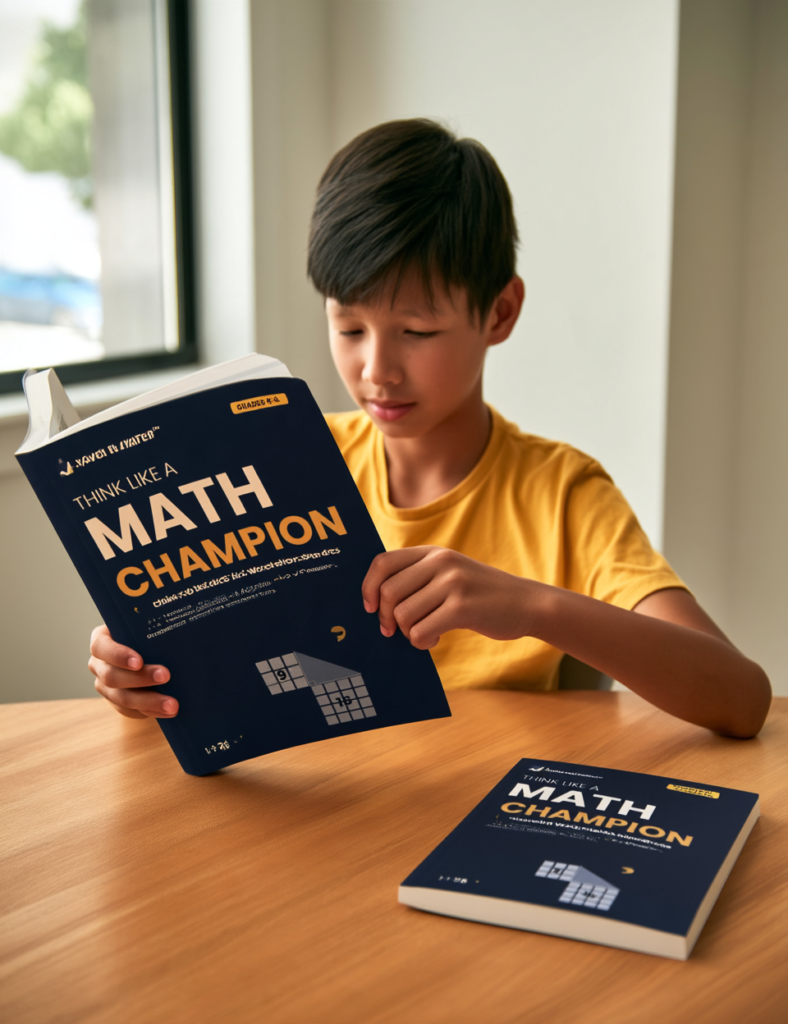
For families who want structured practice that fits around school, sports, and busy weeks, Avatar offers self-paced Olympiad practice contests for grades 4‑8, built on our “Think Like a Math Champion” series.
- Two grade bands, Grades 4‑6 and Grades 6‑8, which line up well with the MOEMS contest divisions
- 25 online practice contests per grade band, in five levels from Warm-up to Champion
- Ten problems per contest, scored the moment your child finishes
- Gold, Silver, and Bronze medals based on your child’s best attempt, with retakes allowed
- A worked solution for every problem, often with “another way” to think about it
- A student portal that tracks medals and strategy progress
Contest 1 in each grade band is free, so your child can try it before you commit to anything. Every problem was written by Avatar’s own team in the style of popular competitions. Avatar Learning Center is not affiliated with or endorsed by MOEMS.
Coming Soon: “Think Like a Math Champion” Books on Amazon
Avatar’s “Think Like a Math Champion” books, for Grades 4‑6 and Grades 6‑8, are coming soon on Amazon. They pair strategy lessons with contest-style practice for students who like working on paper. We will share the link as soon as they are available.
What Parents Should Expect From the First MOEMS Contest Season
A first MOEMS contest season is often less about trophies and more about growth. Students may initially get only a portion of questions correct. That is normal. The most encouraging signs are often quieter: they begin drawing diagrams on their own, check whether an answer makes sense, or stay with a problem longer before asking for help.
Competition results can provide useful feedback, but they are only one measure. A student who learns to handle an unfamiliar question with patience is building a skill that supports algebra, geometry, science, coding, and future academic challenges.
“Hard math is not something to fear. It is something students can learn to figure out.”
Beyond MOEMS: Other Contests Worth Knowing
The MOEMS contest is often a student’s first math competition, and the skills carry over well. Many students also take Math Kangaroo, held each spring, and middle schoolers often move on to the MAA AMC 8. For a side-by-side look at these options, see our post on olympiads such as MOEMS, Math Kangaroo, and AMC 8.
MOEMS Contest FAQ for Parents
What grades can take the MOEMS contest?
The MOEMS contest is for grades 4‑8. Division E covers grades 4‑6, and Division M covers grades 6‑8. Sixth graders can compete in either division.
How many problems are on each MOEMS contest?
Each MOEMS contest has five problems. Over the full five-contest season, students attempt 25 problems in total.
When is the last MOEMS contest of the 2026‑2027 season?
The fifth contest window runs from March 1 to March 29, 2027, and all scores must be entered by March 31, 2027. Your school or program sets the exact day.
Does my child need advanced math to start MOEMS?
No. Students do not need advanced algebra. They do need comfortable number sense and core skills such as fractions, decimals, ratios, and basic geometry, plus a willingness to try a second approach when the first one does not work.
How much should my child practice for the MOEMS contest?
Most students do well with two or three focused sessions a week of about 25 to 40 minutes, plus a careful review after each contest. Consistency matters far more than long cramming sessions.
Is the MOEMS Contest Right for Your Child?
Give your child permission to be a beginner. With steady practice, clear feedback, and problems that are challenging at the right level, the MOEMS contest can become a place where they discover that hard math is not something to fear. It is something they can learn to figure out.
If you are not sure where your child stands, a good first step is a free assessment with Avatar Learning Center. We will look at your child’s current skills and recommend the best fit, whether that is a live class, self-paced practice, or a few strategies to try at home. You can also try Olympiad Practice Contest 1 for free and see how your child responds.