
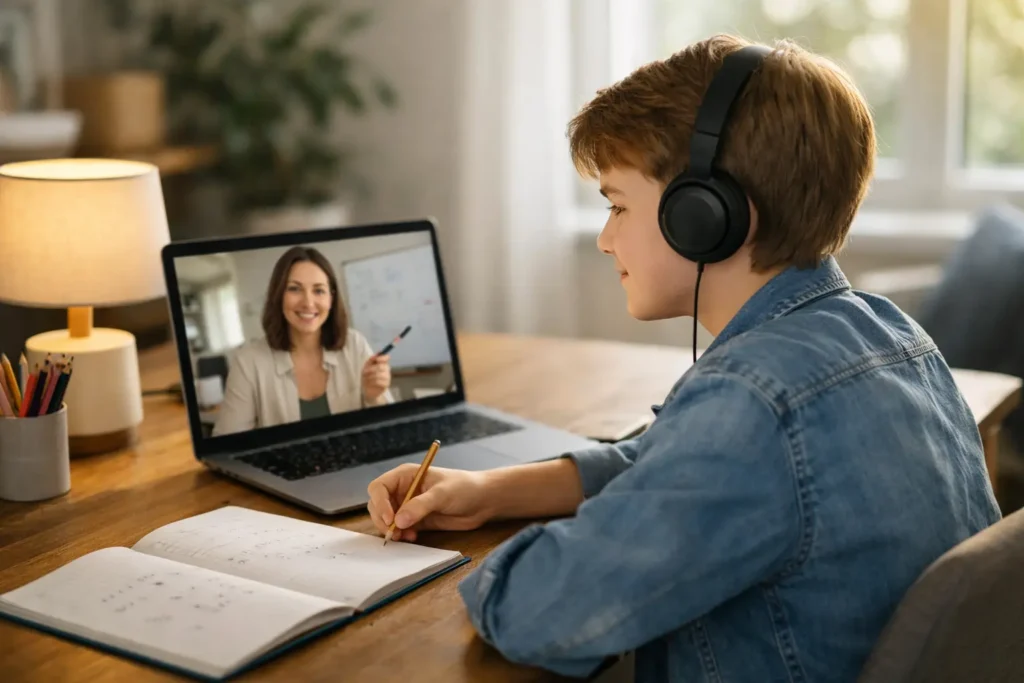
A student who understands fractions on Tuesday can still freeze during Thursday’s quiz. That gap between knowing and performing is where many parents start asking a very practical question: does online tutoring improve grades? The honest answer is yes — often significantly — but only when the tutoring is structured, personalized, and focused on the actual reasons a student is struggling in the first place.
Grades are not just a reflection of intelligence. They reflect consistency, skill gaps, confidence, teacher expectations, test performance, and how well a student keeps pace with the curriculum. Online tutoring can improve grades because it gives students targeted support in the exact places school often cannot — whether that means reteaching a missed algebra concept, practicing problem-solving under guidance, or building enough confidence to raise a hand and participate again.
Does Online Tutoring Improve Grades in Real Life?
For many K–12 students, yes. Online tutoring works best when grades are slipping because of incomplete understanding, weak study habits, inconsistent practice, or a mismatch between classroom pacing and the student’s learning needs. In those cases, tutoring can create visible improvement within weeks — especially in math and science, where each concept builds directly on the last.
That said, tutoring is not magic. If a student logs in half-focused, avoids assignments, or receives generic help that does not match school standards, the impact will be limited. Parents deserve a realistic answer: online tutoring improves grades when it changes the student’s learning process — not just when it adds more screen time.
Research consistently supports this. A landmark study by education researcher Benjamin Bloom found that one-on-one tutoring could push the average student to outperform 98% of peers in a traditional classroom — a finding that still shapes how educators approach personalized instruction today. More recently, the Brookings Institution has identified high-dosage tutoring as one of the most evidence-backed academic interventions available to K–12 students.
Why Online Tutoring Can Raise Grades
Precision: Instruction Stops Where Confusion Starts
The biggest academic advantage of tutoring is precision. In a classroom, a teacher has to move the whole group forward. In tutoring, instruction can stop exactly where confusion starts.
A student may be earning C’s in math not because the current chapter is too hard, but because multiplication facts never became automatic two years earlier. Another student may know the science content but lose points because they cannot organize lab responses clearly. Strong tutoring identifies the actual cause of the grade problem and addresses it directly — not just the symptom on the most recent test.
Consistency Without the Commute
Online tutoring also improves access to consistent support. Families do not have to spend time commuting, and students can meet with highly qualified instructors from home. That convenience matters more than it may seem. When academic support is easier to maintain, students attend more regularly — and regularity is what creates momentum.
Confidence That Comes Before the Grade Improves
There is also an emotional benefit worth naming. Many students protect themselves by saying a subject is “boring” or “impossible” when what they really feel is embarrassment. In a smaller online setting, students are far more likely to ask questions, make mistakes, and try again. Better grades often follow growing confidence — not the other way around.
Research published by Edutopia confirms that personalized learning environments — exactly what skilled tutoring provides — are strongly linked to improved academic motivation and self-efficacy in K–12 students.
What Makes Online Tutoring Effective Enough to Change Grades?
Not all tutoring produces the same results. The strongest programs are built around three pillars: diagnosis, alignment, and accountability.
Diagnosis comes first. A tutor needs to know whether a student is missing prerequisite skills, misunderstanding current material, rushing through work, or simply lacking practice. Without this first step, tutoring can become repetitive homework help instead of real academic intervention. A placement assessment removes the guesswork entirely, giving families a clear picture of exactly where to start.
Alignment matters just as much. If a student is learning one method in school and a completely different one in tutoring, frustration increases. Effective tutoring connects directly to the student’s grade level, curriculum, and teacher expectations — while still strengthening deeper conceptual understanding. The National Council of Teachers of Mathematics (NCTM) emphasizes that lasting math achievement requires both procedural fluency and conceptual understanding, which is precisely what aligned, expert instruction builds.
Accountability is the piece families often overlook. Students improve faster when there is a system for attendance, progress checks, parent communication, and measurable goals. A tutoring relationship should never feel vague. Parents should know what is being worked on, what progress is being made, and what the next milestone looks like.
When Online Tutoring Helps the Most
Online tutoring is especially effective in STEM subjects because those subjects are cumulative. If a student misses one foundational idea, the next unit often becomes harder — and grades can drop quickly.
- Elementary math: Tutoring can help build number sense before small struggles become lasting gaps.
- Middle school: It can stabilize pre-algebra and algebra readiness before students enter more demanding coursework.
- High school: Tutoring often has the strongest grade impact when students face Algebra, Geometry, Pre-Calculus, Chemistry, Physics, or coding classes that require both logic and precision.
It is also highly effective for students who are capable but underperforming. Some students understand the material yet lose points through careless errors, weak test preparation, or low confidence. For them, tutoring is not remediation — it is performance coaching. The goal is to turn inconsistent ability into reliable, repeatable results.
Students preparing for accelerated tracks, math competitions like Math Kangaroo or MOEMS, or summer school recovery can also benefit significantly. In those cases, better grades are only one outcome — tutoring also builds the speed, precision, and readiness that advanced work demands.
Why Some Students Do Not See Better Grades Right Away
This is where nuance matters, and parents deserve honesty. Sometimes a student is learning more, but the grade does not move immediately.
Timing. If tutoring starts after several low test scores, it may take a full grading period to recover the average — even if understanding has genuinely improved.
School policy. Homework completion, class participation, late assignments, and retake rules all affect grades, even when content mastery is growing.
Depth of gaps. A student with large foundational gaps may need several weeks of rebuilding before current classwork feels easier. That is not tutoring failing — it often means the tutoring is addressing the right problem instead of covering it up.
Parents should watch for leading indicators before the report card changes. Is homework getting easier? Is the student asking stronger questions? Are quiz scores ticking up? Is there less resistance around the subject? Those signs almost always appear before major grade growth on a report card.
Does Online Tutoring Improve Grades Better Than In-Person Tutoring?
Not automatically. The better question is which format fits the student and the instruction.
Online tutoring can be extremely effective because it offers scheduling flexibility, easy access to specialized STEM instructors, interactive digital tools, and a comfortable home environment. For many students — especially those accustomed to learning with technology — this format feels natural and efficient.
In-person tutoring may be better for students who struggle heavily with focus, need close physical redirection, or respond best to face-to-face presence. That said, online tutoring has closed that gap more than many parents expect. Research highlighted by the What Works Clearinghouse, part of the U.S. Department of Education’s Institute of Education Sciences, confirms that structured small-group and one-on-one tutoring consistently produces positive outcomes regardless of delivery format — when instruction quality is high.
The real difference is never the screen. It is the quality of teaching, the level of personalization, and whether the student is actively participating.
How Parents Can Tell If Tutoring Is Working
The most reliable way to evaluate tutoring is to watch both academic and behavioral changes.
A student who is genuinely improving usually becomes more independent with homework, less anxious about tests, and more willing to attempt challenging problems. Grades may rise from failing to passing, from average to strong, or from inconsistent to stable. In some cases, the biggest early win is not an A — it is a student who no longer says, “I’m just bad at math.”
Parents should also expect clarity from the provider. A strong academic partner will explain what the student needs, what skills are being developed, and how progress is tracked. At Avatar Learning Center, structured placement, small-group attention, and regular progress communication are built into the program — designed to connect instruction to real outcomes parents can see.
What to Look for If Your Goal Is Better Grades
If your family is considering tutoring primarily to improve school performance, choose a program that does more than answer homework questions. Look for instruction that is curriculum-aware, skill-based, and led by educators who understand how STEM learning develops over time.
Also consider the setting. Some students thrive one-on-one because they need intensive, focused support. Others do very well in small groups where they gain both individual attention and healthy academic motivation from peers. The right environment can raise both mastery and confidence simultaneously.
Most of all, look for evidence of a plan. Better grades usually come from a chain reaction:
- Identify the gap
- Teach the concept with expert instruction
- Practice with immediate feedback
- Build confidence through small wins
- Improve test and homework performance
- Sustain it through consistency
When tutoring follows that sequence, grades are much more likely to move in the right direction — and stay there.
Frequently Asked Questions About Online Tutoring and Grades
Does online tutoring really improve grades, or is it just extra homework?
Done correctly, online tutoring is fundamentally different from extra homework. It is live, responsive, and personalized — a skilled tutor adjusts in real time based on what the student understands and what they don’t. Most families who commit to consistent sessions report noticeable grade improvement within one to two grading periods.
How quickly will my child’s grades improve with online tutoring?
Timelines vary. Students with smaller, recent gaps may see improvement within four to six weeks. Students with deeper foundational gaps may need a full semester of consistent work. Frequency matters too — two sessions per week typically produces faster results than one. Watch for leading indicators first: easier homework, better quiz scores, and less subject avoidance usually appear before report card improvement.
Is online tutoring as effective as in-person for K–12 students?
For most students, yes. Research increasingly shows that live, interactive online instruction delivers results comparable to in-person tutoring — especially in math and science. Many families prefer online tutoring for the scheduling flexibility and access to specialists who may not be available locally.
At what age should I start tutoring my child?
There is no single right age. Some students benefit from foundational support as early as 2nd or 3rd grade. Others don’t need help until math becomes abstract in middle school. The real signal is whether struggles are ongoing rather than occasional. A free placement assessment removes the guesswork and gives you a clear starting point.
What subjects benefit most from online tutoring?
Math and science benefit most because they are cumulative — gaps compound quickly. Reading comprehension and writing also respond very well to personalized tutoring, especially in elementary and middle school years. Test preparation for standardized assessments like the SAT and ACT is another area where focused, one-on-one or small-group tutoring consistently produces measurable score improvement
The Bottom Line
Online tutoring is not a shortcut. It is a strategic investment in how a student learns, thinks, and performs. When the teaching is expert, the instruction is personalized, and the student is supported consistently, better grades are not just possible — they become a natural result of stronger understanding.
For parents who want more than a quick fix, that is the kind of progress that can genuinely change a child’s academic future.
Curious where your child stands right now? Schedule a free placement assessment with Avatar Learning Center — we’ll identify exactly what they need and build a clear, personalized plan from day one.