
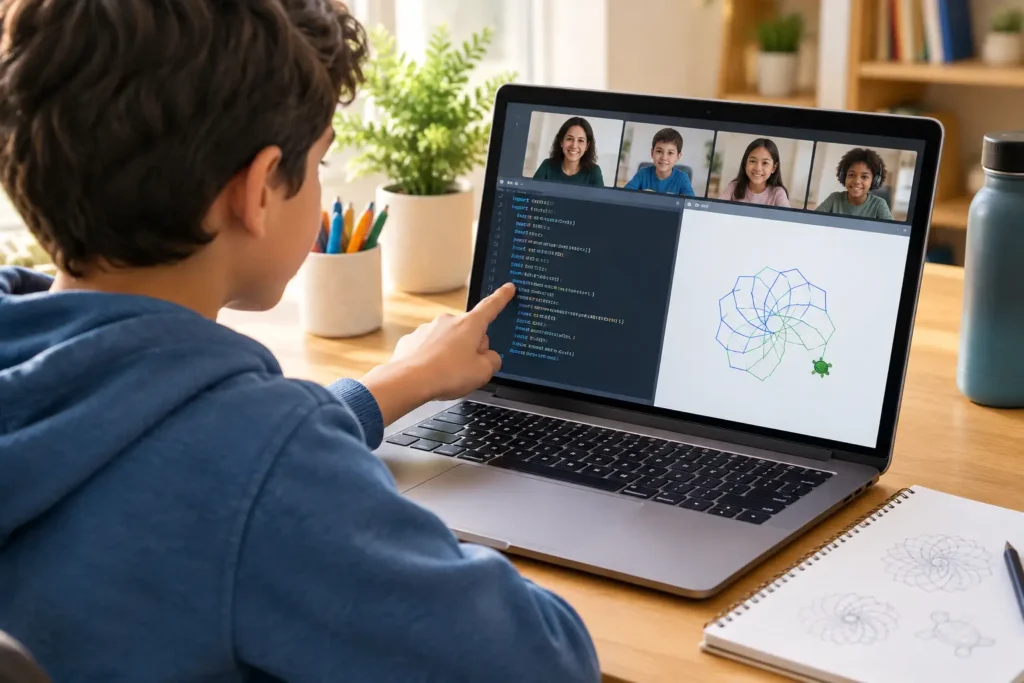
Quick answer: The best online Python classes for kids are small, scheduled, and taught by a live instructor who can see a student’s code while they write it. Look for a clear skill progression, original projects instead of copy-the-clicks activities, and specific feedback rather than “good job.” A trial lesson or placement conversation before you commit matters more than any advertised curriculum, because the right starting point is what keeps a child challenged instead of bored or overwhelmed.
A child’s first Python program may be a guessing game, a drawing made with turtle graphics, or a few lines that print a silly story. What matters most is what happens when it does not work the first time. In strong online Python classes for kids, students learn to read an error message, test an idea, revise their work, and try again with guidance from a real instructor. That process builds more than technical skill. It builds patience, reasoning, and confidence.
For parents, the question is not simply whether coding is useful. It is how to choose a class where a child is actively thinking instead of clicking through lessons alone. The right environment gives students enough support to make progress while still letting them do the intellectual work themselves.
Why Python is a good first real language
Python reads close to plain English, which lowers the cost of entry for a child moving past drag-and-drop blocks. A line like `print(“Hello”)` does roughly what it looks like it does. That matters for young learners, because the mental energy goes into the logic instead of into punctuation.
Python is also not a toy. It is used in data analysis, scientific research, web development, and automation, so a student who starts here is learning a language they can keep. The same syntax that draws a square with turtle graphics in third grade will later handle lists, functions, and files, as the official Python tutorial lays out.
Finally, Python makes errors visible and readable. An error message names the line and the problem. In live online Python classes for kids, that message becomes a teaching moment rather than a dead end.
What children gain from online Python classes for kids
Coding gives abstract thinking a visible result. A student can change one value and immediately see a shape appear in the wrong place, a loop run twice too often, or a game respond as intended. That quick feedback helps children connect cause and effect in a concrete way.
Over time, students begin to organize a problem into smaller steps. They may decide what should happen first, identify a repeated pattern, or consider why a condition is not working. These are foundational habits for computer science, but they also transfer to math, science, writing, and everyday problem-solving — they line up closely with the Standards for Mathematical Practice, which ask students to make sense of problems and persevere in solving them.
Live instruction adds an essential layer: conversation. When an instructor asks, “What did you expect this code to do?” or “What could we test next?” the student has to explain their reasoning. That explanation reveals misunderstandings early and helps children learn that mistakes are information, not evidence that they are “bad at coding.”
Python class is not just screen time
Parents are right to be selective about screen-based activities. Passive entertainment and active creation are not the same experience. A well-designed class asks students to predict, build, test, explain, and improve. The computer is a tool for making ideas visible, not a substitute for teaching.
Still, screen time alone does not make an activity educational. A prerecorded course can work for a highly independent older student who already knows how to troubleshoot and stay organized. Younger children and students new to programming usually benefit more from scheduled lessons, clear expectations, and immediate feedback from an instructor. That is the practical difference between a video library and live online Python classes for kids.
Why small online Python classes for kids matter
Class size changes the learning experience. In a large online class, an instructor may not notice that a student copied a solution, misunderstood indentation, or quietly gave up after a traceback appeared. In a small group, the instructor can see students’ work, ask follow-up questions, and adjust support before frustration becomes disengagement.
Small groups also create a healthy form of peer learning. Students can hear how another child approached the same challenge without being lost in a crowded virtual room. They may discover that there is more than one way to solve a problem, which is an important lesson in both programming and mathematics.
At Avatar Learning Center, small live classes are designed to give children direct instructor attention while preserving the motivation that comes from learning alongside peers. For Python, as in math, the goal is not to rush through material. It is to build understanding that students can use independently. Because classes meet online, families anywhere can join without adding a commute to an already full week.
Matching group size to your child’s age
The right size for online Python classes for kids depends somewhat on age and experience. Early elementary students often need frequent check-ins, especially while learning to use a new editor. Middle and high school students may work more independently, but they still benefit from timely feedback when projects become more complex. A class capped at a manageable size gives the instructor room to respond to both needs.
| Stage | Typical Python focus | What live support looks like |
|---|---|---|
| Grades 2–4 | print, variables, turtle drawing, simple loops | Frequent check-ins, help with typing and syntax |
| Grades 5–6 | Conditionals, input, lists, first real projects | Guided debugging, questions that prompt prediction |
| Grades 7–8 | Functions, nested loops, small games | Code review, planning before building |
| Grades 9–12 | Data structures, files, algorithms, portfolio work | Feedback on structure, efficiency, and problem choice |
7 signs of strong online Python classes for kids
When you compare online Python classes for kids, these seven signs separate a real course from a packaged activity:
- A visible skill progression. You can see what comes after this unit, not just a list of fun projects.
- Live, scheduled meetings with a named instructor, not a video queue with office hours.
- Small groups where the instructor can watch code being written in real time.
- Original projects that require choices, instead of identical typing producing identical results.
- Specific feedback tied to the student’s own code.
- A trial lesson or placement step before you commit to a term.
- Evidence of progress parents can actually look at, such as saved project files.
What a strong Python curriculum should include
Good online Python classes for kids follow a clear sequence, even when projects are creative. Children need to understand what skill they are practicing and how today’s lesson connects to the next one. Without a progression, students may produce impressive-looking projects while missing the underlying concepts needed to advance. Frameworks such as the CSTA K–12 Computer Science Standards are a useful reference when you ask a provider what their sequence is built on.
For beginning learners, instruction usually starts with output, variables, input, loops, and simple conditionals, often alongside turtle graphics so results are visual. As students gain confidence, they can move toward functions, lists, dictionaries, and longer structured projects. The pace should match the student’s readiness, not just their grade level or the course calendar.
Look for classes that balance direct instruction with hands-on work. An instructor should introduce a concept clearly, model how to use it, and then give students time to apply it. Projects are valuable when they require choices and problem-solving, not when every child types the same lines to reach an identical result.
Feedback should be specific. “Good job” is encouraging, but it does not tell a student what they did well or what to improve. More useful feedback sounds like, “Your loop removed repeated code,” or “Your game works, but let’s check what happens when the score reaches zero.” This helps students develop an accurate picture of their own skills.
A curriculum should grow with the child
A child who has completed a few coding activities may not need to start over at the beginning. At the same time, a student who has watched tutorials may have gaps in core concepts. A trial lesson, sample task, or introductory assessment can help identify an appropriate starting point.
This matters because boredom and overwhelm can look similar from the outside. A bored student may rush, distract others, or say Python is pointless. An overwhelmed student may avoid starting or insist they are not good at technology. Thoughtful placement helps both students find productive challenge.
Is my child ready to move from blocks to Python?
There is no fixed age for the switch. A reasonable signal is that a student can plan a project before building it, debug a loop without help, explain what a variable is holding, and type comfortably enough that spelling is not the main obstacle. Children who are not there yet are usually better served by a block-based environment such as Scratch first, then Python a term or two later.
How beginner, intermediate, and advanced levels usually differ
Levels in online Python classes for kids should describe what a student can do, not how long they have attended. A useful way to think about the three common tiers:
| Level | Student can already | Typical work |
|---|---|---|
| Beginner | Little or no text-based coding | Syntax, variables, loops, turtle drawings, first small programs |
| Intermediate | Write and fix simple programs | Functions, lists, conditionals inside loops, multi-part projects |
| Advanced | Plan and debug independently | Data structures, files, algorithms, contest-style problems |
At Avatar Learning Center, the first Python lesson is free, so a student can try the format and an instructor can see where that child actually belongs before any payment. Beginners then enroll for a short two-to-four-week session rather than a long contract, which keeps the commitment small while a family decides whether the fit is right. Intermediate and advanced classes are paid programs that continue from there, and students who want more challenge can look toward AP Computer Science Principles or contests like the USA Computing Olympiad.
5 questions parents can ask before enrolling
Before choosing among online Python classes for kids, ask these five questions:
- How do you determine my child’s starting level?
- What happens in class when a student is stuck?
- Do children build original projects, or follow the same steps as everyone else?
- How often do students get individual feedback, and what does it sound like?
- How will I see evidence of progress?
It is also reasonable to ask about the instructor’s background. Technical knowledge matters, but teaching skill matters just as much. An effective instructor can translate a complex idea into age-appropriate language, recognize when a child is stuck, and encourage persistence without taking over the work.
Consider the practical details as well. Is the class held live on a dependable schedule? Are there clear expectations for participation? Is there a way to review assignments or project outcomes? Families have busy schedules, so convenience matters, but convenience should not come at the cost of interaction and accountability.
Parents should also be cautious about promises that Python will instantly transform a child into a future software engineer. Programming can open exciting academic and career pathways, but its immediate value is broader. It teaches children to approach difficult tasks with logic, creativity, and resilience.
6 simple ways to support Python learning at home
You do not need to know Python to support what your child is learning in online Python classes for kids. These six habits help:
- Ask your child to show you what they made and explain one decision they had to make.
- Use open questions such as “What was the hardest part?” and “What would you change next time?”
- Let them struggle briefly before you search for an answer.
- Encourage them to read the error message out loud and check one line at a time.
- Have them describe what they already tried, then bring that to the instructor.
- Celebrate effort and revision, not just polished results.
A child who learns to fix a bug has often gained more than a child who finished a project without any obstacles. Research on growth mindset suggests that how students interpret difficulty affects whether they keep going, which is one reason debugging deserves as much praise as a finished game.
Frequently asked questions about online Python classes for kids
What age should a child start Python? Many children are ready for Python around ages 8 to 10, once they can type reasonably and follow written instructions. Most online Python classes for kids set a minimum age for that reason; younger children usually do better starting with block-based coding, then moving to Python a year or two later.
Are online Python classes for kids better than self-paced videos? For most beginners and younger students, yes. Live classes provide scheduled accountability and immediate feedback on code the instructor can actually see. Self-paced courses work better for an older, independent student who already knows how to troubleshoot.
Does my child need coding experience to start? No. Beginner classes assume no prior experience. A free trial lesson is the simplest way to confirm the level, since an instructor can watch how a child handles a first unfamiliar task.
How small should an online Python class be? Small online Python classes for kids work best when the instructor can see each student’s code during the lesson and respond before frustration sets in. Ask for the cap, and ask what happens when two students need help at once.
Does my child need to be good at math to learn Python? No. Early Python relies on sequencing and logic more than arithmetic. Over time, programming and math reinforce each other, especially around patterns, variables, and conditions. Free practice tracks like Khan Academy’s computing courses make that overlap easy to see.
Finding the right fit for your child
The best live Python experience gives children a place to be curious, make mistakes safely, and see their ideas take shape. When instruction is live, class sizes are small, and progress is visible, coding becomes less about getting the right answer quickly and more about learning how to think through the next problem.
If you are comparing online Python classes for kids, start with fit rather than schedule. A free first lesson and a short beginner session are low-risk ways to find out where your child should begin, and an instructor can tell you honestly whether the level is right before you continue.