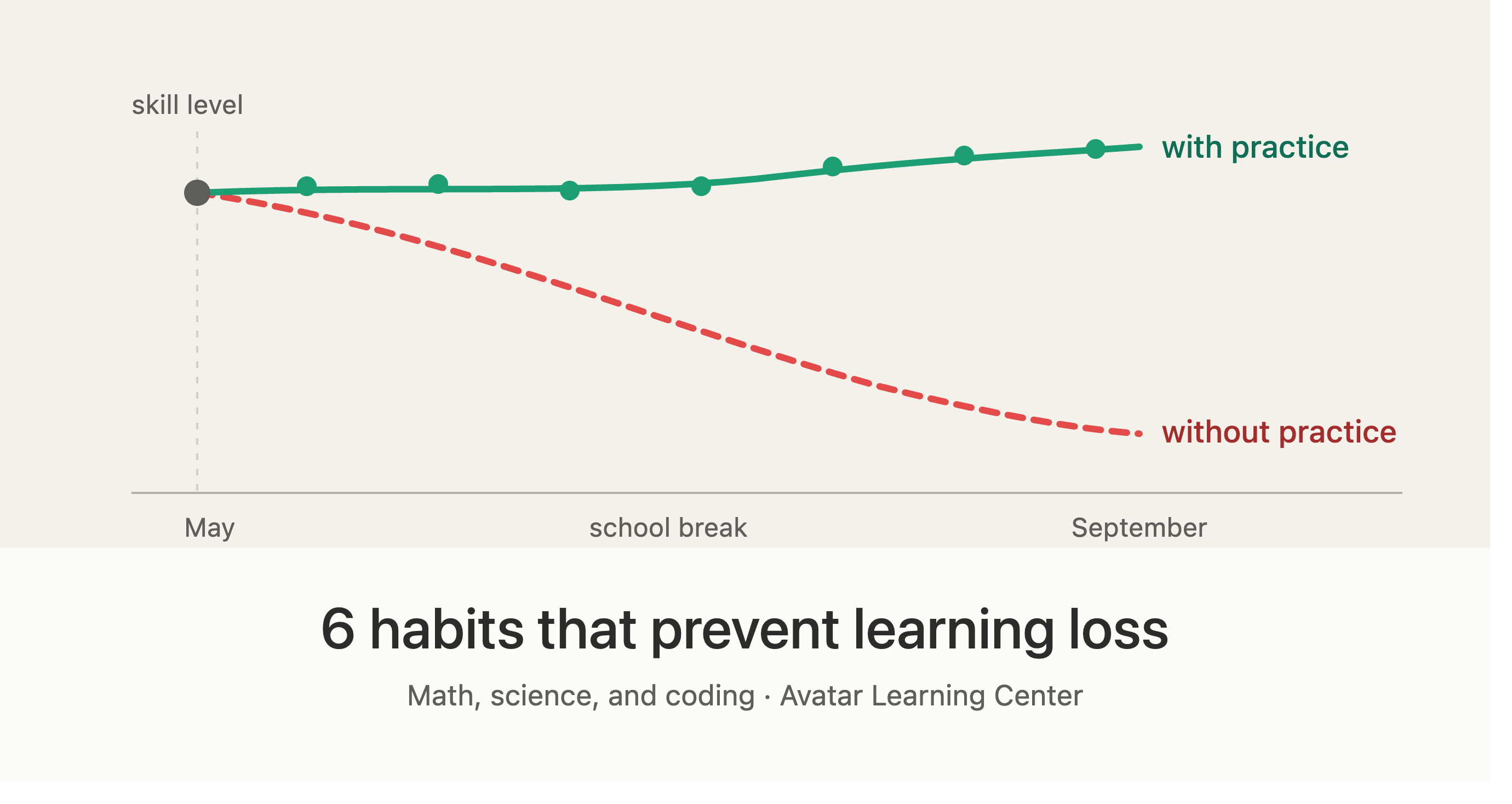
How to Prevent Summer Math Slide at Home
How to Prevent Summer Math Slide: 6 Proven Habits That Keep Math, Science, and Coding Skills Sharp
If you are wondering how to prevent summer math slide, start with what happens in an ordinary week — not with a workbook in late August. A child can earn a solid grade in May and still feel lost when a familiar skill appears again in September. That does not mean they are incapable. It often means the skill was memorized for a test but never practiced long enough to become dependable. The best ways to prevent summer math slide build steady recall, deeper understanding, and the confidence to tackle challenging work without immediately giving up.
For parents, the goal is not to turn every school break into a second school day. It is to protect the academic foundation that makes future learning easier — especially in math, science, and coding, where each new concept depends on what came before. A thoughtful routine now can prevent small gaps from becoming frustrating obstacles later.
Quick Answer: How to Prevent Summer Math Slide
Short version, if you only have a minute:
- 20 to 40 focused minutes, several days a week beats long marathon sessions before school starts
- Retrieval over rereading — recalling from memory, not reviewing notes that already look familiar
- Mixed practice that combines current skills with earlier ones, so students must choose a strategy
- Active science and coding — predicting, testing, debugging, not memorizing vocabulary
- Specific feedback early, before mistakes get rehearsed into habits
- Protecting confidence, since avoidance is what turns a small gap into a large one
Why Summer Math Slide Becomes a Bigger Problem in STEM
Learning loss is most often discussed as a summer issue — the familiar summer math slide — but it can happen after any extended break, during a busy sports season, or when a student moves through a class without fully understanding key material. A student may remember multiplication facts one week and hesitate over them the next. An Algebra student may know how to follow a sample problem but struggle when the numbers or wording change.
STEM subjects are cumulative. Weak fraction fluency can make ratios, decimals, percentages, and Algebra harder. Uncertainty with variables can follow a student into Geometry, Chemistry, Physics, and coding. National results on The Nation’s Report Card show how much unfinished math learning students carry forward from one year to the next — and how difficult it becomes to close once it accumulates.
The problem is not simply that information fades. Students can also lose the belief that they are capable of figuring things out.
That is why any plan to prevent summer math slide should focus on both knowledge and habits. The strongest plan gives students frequent opportunities to retrieve what they know, apply it in new situations, receive feedback, and see their own progress.
How to Prevent Summer Math Slide: 6 Habits That Build Consistent Practice
1. Build a realistic weekly rhythm
A sustainable weekly rhythm is the foundation of everything else here. Long, infrequent study sessions are rarely the answer. A student who practices for 20 to 40 focused minutes several days a week will usually retain more than one who spends hours reviewing only at the end of a break.
This is one of the most consistent findings in learning research. A major review of study techniques rated distributed practice — spacing sessions out over time — among the highest-utility strategies available, well ahead of the cramming most students default to. Consistency gives the brain repeated chances to strengthen connections.
The right amount depends on age, subject, and current need:
- Early elementary: short number games, counting, and read-aloud conversations
- Upper elementary and middle school: two to four short sessions a week across math and reading
- High school: several structured sessions weekly to maintain Algebra, Pre-Calculus, or lab science skills
The routine should be challenging enough to matter but manageable enough that families can sustain it.
Set a predictable time and protect it. For many families, mornings or the period just after a snack work better than late evenings, when attention is already low. Keep the expectation clear: this is not punishment or extra homework. It is training for a stronger academic future.
2. Practice retrieval, not just review
Rereading notes can feel productive because the material looks familiar. But familiarity is not the same as mastery — and the same research review that endorsed spaced practice rated rereading and highlighting among the least effective techniques, while practice testing ranked at the top. Students retain more when they must bring information to mind without seeing the answer first.
Try this instead of review:
- Ask your child to solve a few problems from memory, with notes closed
- Have them explain a science idea in their own words
- Ask them to teach you the steps they used to reach an answer
- For coding, have them predict what a short program will do before running it, then find and fix an error
These small moments reveal whether learning is truly secure.
When a student misses a question, avoid rushing to provide the solution. Ask, “What do you remember?” or “Which part makes sense so far?” Productive struggle is valuable when it is supported. The goal is to help students reconnect with what they know and build a path forward.
3. Keep math skills active with mixed practice
Mixed practice is the most direct answer to summer math slide in math itself. Math is usually the first area where parents notice a decline, because fluency affects speed, accuracy, and confidence. The most effective practice does not repeat only one type of problem at a time. Instead, mix current-level skills with earlier concepts.
- An upper elementary student might work with multiplication, fractions, and word problems in the same session.
- A middle school student might combine integer operations, ratios, equations, and geometry questions.
This forces students to decide which strategy fits — a far more powerful skill than copying a method they just used, and the kind of reasoning the National Council of Teachers of Mathematics places at the center of mathematics learning. Interleaving problem types this way takes more effort in the moment and often feels harder, which is exactly why it works better than blocked practice.
One caution on fluency: speed drills are not the only path to it. Stanford’s youcubed research team argues that timed testing is a significant source of math anxiety for many students. Fluency still matters, but it is built more reliably through repeated, unhurried practice than through a stopwatch. If math already triggers stress in your home, our guide to helping a child overcome math anxiety pairs well with this routine.
Accuracy matters, but so does explanation. If a child gets the right answer, ask how they knew. If they get it wrong, look for the misconception. A reversed operation, a skipped step, or a misunderstanding of place value tells you more than a score alone.
4. Make science and coding active, not passive
Science learning fades when it becomes a collection of vocabulary words. Keep curiosity alive by asking students to observe, predict, test, and explain.
- While cooking: discuss measurement, temperature, and chemical changes
- During a walk: notice patterns in plants, weather, shadows, or motion
- Anytime: ask a question with more than one possible starting point — “What evidence would help us figure that out?”
These informal conversations matter more than they look. One large study found that families who simply talked about numbers and quantities during ordinary routines saw meaningfully stronger math growth across the school year.
Coding offers a particularly strong way to preserve logical thinking. Students do not need an elaborate project every week. They can write a short program, modify a familiar one, trace the logic of an algorithm, or solve a puzzle using conditionals and loops. The key is creating, testing, and revising. Those are the habits that prepare students for increasingly complex computer science work.
5. Use feedback before frustration takes over
Independent practice is useful, but students can rehearse mistakes when no one checks their reasoning — one of the quietest causes of summer math slide. Review work regularly and make feedback specific. “Check your work” is less helpful than “Your equation setup is correct, but let’s look at why the negative sign changed here.”
Parents do not need to be subject experts to provide meaningful support. You can:
- Ask your child to explain their thinking out loud
- Have them compare their answer with a worked example
- Ask them to identify the first step where they became unsure
Free tools can help you pinpoint where a gap begins. Khan Academy offers structured lessons by grade level, while IXL and Education.com provide targeted practice by specific skill.
If the same confusion appears repeatedly, that is a signal to seek targeted instruction rather than hoping the issue disappears with more worksheets. Small-group classes and one-on-one tutoring can be especially effective when a student needs a precise explanation, accountable practice, and a plan that matches their level. A placement assessment helps distinguish between a temporary lapse and a foundational gap that needs focused attention.
6. Protect confidence along with academic skills
Confidence is the part of summer math slide that parents most often overlook. Students are more likely to avoid practice when they associate a subject with embarrassment or repeated failure, and that avoidance accelerates the decline. Parents can interrupt the cycle by praising effective habits rather than labeling a child as naturally “good” or “bad” at math.
The distinction is well established: in classic research on motivation, children praised for their intelligence gave up faster after a setback than children praised for their effort and strategy. Notice persistence, careful reasoning, willingness to correct errors, and progress over time.
Use language that leaves room for growth: “You have not mastered this yet,” rather than “You are behind.” This is not empty encouragement. It teaches students that ability develops through guided effort and sound strategy.
It also helps to set goals that students can see:
- Complete multiplication facts with greater accuracy
- Explain two different fraction models
- Finish a coding challenge independently
- Solve multi-step word problems without prompting
Clear wins create momentum, and momentum makes practice easier to continue.
Know When a Gap Needs More Than Home Practice
Home routines are powerful, but they are not a substitute for specialized support in every situation. Consider additional help if your child:
- Consistently avoids a subject
- Cannot explain work they previously completed
- Needs excessive time for grade-level tasks
- Becomes distressed by assignments that should be manageable
A sudden drop in confidence can be as meaningful as a drop in grades.
The right support should not simply push students through more content. It should identify what they missed, rebuild the concept carefully, and give them enough guided practice to use the skill independently.
For advanced learners, prevention may mean the opposite: providing enrichment so they remain engaged, curious, and ready for greater challenge. Students aiming toward AP math and science coursework benefit from staying ahead of the sequence rather than simply maintaining it.
At Avatar Learning Center, structured small-group instruction and personalized STEM tutoring help students prevent summer math slide while building the problem-solving habits needed for advanced work. The objective is not short-term test preparation alone. It is a student who can enter the next unit, grade, or academic challenge with real confidence.
Frequently Asked Questions About Summer Math Slide
How do I prevent summer math slide without turning the break into school?
Keep the footprint small and the schedule predictable. Three sessions of 20 to 40 minutes a week, at a consistent time, are enough to prevent summer math slide for most students — and short enough that the rest of the break still feels like a break.
How much practice does my child need over a school break?
For most students, 20 to 40 focused minutes several days a week is enough to maintain skills. Frequency matters more than duration — three short sessions spread across a week outperform one long session on Sunday.
Which subjects are most affected by learning loss?
Math is usually the first place parents notice it, because fluency directly affects speed and accuracy on the next unit. Science and coding follow closely, since both depend on reasoning skills that fade without regular use. All three are cumulative, which is why gaps compound rather than stay contained.
How do I know if it’s a temporary lapse or a real gap?
A temporary lapse resolves after a few sessions of review. A real gap persists: your child cannot explain work they once completed, the same confusion resurfaces repeatedly, or grade-level tasks take far longer than they should. A placement assessment gives a clear answer rather than a guess.
Are workbooks enough to prevent summer math slide?
Workbooks can help with practice volume, but they don’t provide feedback — and unchecked practice lets a student rehearse the same mistake dozens of times. Pair any workbook with a weekly review where your child explains their reasoning out loud.
Should my advanced student practice over the break too?
Yes, though the goal shifts from maintenance to enrichment. Advanced learners lose momentum and engagement rather than fundamentals. Give them harder problems, an open-ended project, or a coding challenge instead of repetition of skills they already own.
Start With One Subject and One Routine
A few intentional sessions each week can change the direction of a student’s year. Everything you need to know about how to prevent summer math slide comes down to this: start with one subject, one routine, and one attainable goal. When children experience that they can remember, reason, and improve, learning becomes something they carry forward rather than something they have to recover.
If you’d like help identifying exactly which skills need reinforcing, reach out to Avatar Learning Center for a placement assessment. There’s no pressure — just a clear picture of where your child stands and what comes next.