
Online Math 2 Classes | Live, twice a week, one hour each
Online Math 2 Classes, Live and in Small Groups
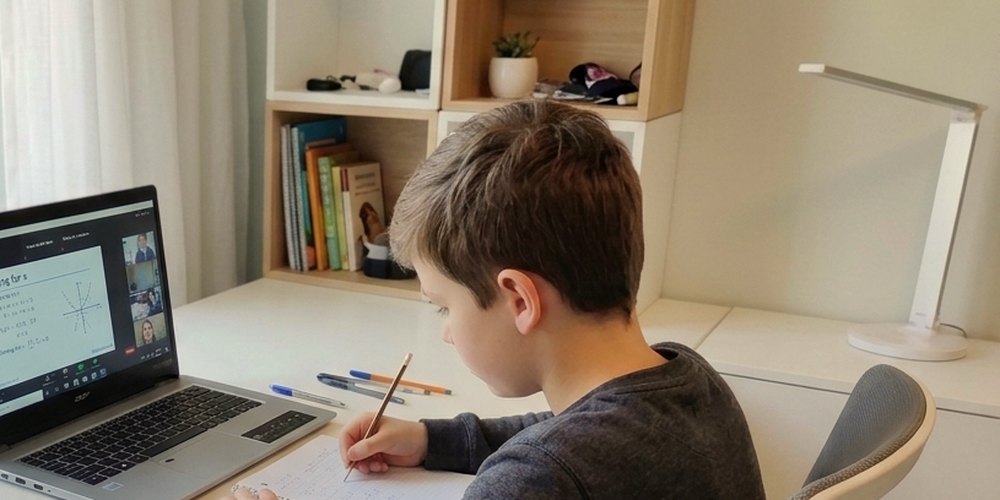
Math 2 is for children in grade 2. It covers addition and subtraction with regrouping, numbers to 1,000, equal groups, money, time and measurement. Classes are live online, interactive and engaging, twice a week for one hour, in a small group of 5 to 6 students, never more than 8, so every child takes part. A free placement assessment places your child in one of three levels: catching up, extra practice or advanced.
About this course
What Math 2 at Avatar Covers
Each week has two classes with their own goals. The year moves from numbers to 100 and addition and subtraction, through regrouping, equal groups and numbers to 1,000, to money, time, measurement, graphs, shapes and equal parts.
Every class has word problems, a facts drill and a spiral review of earlier weeks, so skills are kept up all year rather than learned once and forgotten.
By the end of the course
What Students Can Do After Math 2
Numbers to 1,000
Read, write, compare and round numbers to 1,000 and say what each digit is worth.
Adding and subtracting with regrouping
Add and subtract two- and three-digit numbers with regrouping, and check a subtraction by adding back.
Two-step word problems
Decide whether a story needs adding or subtracting, and solve two-step word problems.
Equal groups and arrays
Write repeated addition for equal groups and arrays, share things equally and tell even from odd numbers.
Money, time and measurement
Count coins, make change from a dollar, tell time to five minutes, find elapsed time and measure lengths.
Graphs, shapes and equal parts
Read and make picture graphs, bar graphs and line plots, and name flat shapes, solid shapes and halves, thirds and fourths.
Course content
The Syllabus, Unit by Unit
Open a unit to see its topics. All three levels follow the same units; the pace, depth and amount of practice differ. Every week has a live class and a homework set checked in the student portal.
Unit 1Numbers to 100 and basic facts4 topics
Reading, writing, comparing and ordering numbers to 100, tens and ones, and ten more and ten less, then addition facts (making ten, doubles, near doubles) and subtraction facts with fact families.
- Numbers to 100Class 1 reads and writes numbers to 100 in digits and words and builds them from tens and ones. Class 2 compares numbers with >, < and =, puts them in order and solves comparing problems.
- Tens and OnesClass 1 builds a number from tens and ones, breaks it apart (47 = 40 + 7) and says what each digit is worth. Class 2 finds ten more, ten less, one more and one less, with patterns on the hundred chart.
- Addition Facts and Making TenClass 1 covers the pairs that make 10, the making-ten strategy (8 + 5) and adding in any order. Class 2 covers doubles, near doubles and adding three numbers.
- Subtraction Facts and Fact FamiliesClass 1 teaches subtraction as taking away, counting back and finding the difference, with facts to 20. Class 2 covers fact families (8, 6 and 14), finding a missing part and checking a subtraction by adding.
Unit 2Two-digit addition, subtraction and word problems6 topics
Adding and subtracting two-digit numbers, first without and then with regrouping, using columns and number lines.
- Adding Two-Digit NumbersClass 1 adds two-digit numbers by adding tens and ones, breaking numbers apart and using a number line. Class 2 adds in columns and adds three numbers.
- Adding with RegroupingClass 1 adds when the ones make ten or more, trading ten ones for one ten and writing the carry (37 + 28). Class 2 adds when both columns are full, adds three numbers with a trade and checks answers.
- Subtracting Two-Digit NumbersClass 1 subtracts two-digit numbers tens first, then ones (68 − 25), on a number line, and by counting up. Class 2 checks by adding, chooses between counting up and columns, and solves two-step problems.
- Subtracting with RegroupingClass 1 subtracts when the ones cannot be taken away, breaking one ten into ten ones (62 − 38). Class 2 subtracts across a ten, checks every answer by adding and solves two-step problems with a borrow.
- Add or SubtractClass 1 draws a story as a bar model and asks whether the missing number is a part or the whole. Class 2 handles comparing (how many more, how many fewer) and chooses the operation without keywords.
- Two-Step Word ProblemsClass 1 solves problems that take two steps by finding the hidden question and writing down the middle answer. Class 2 checks answers, ignores a number that is not needed and spots problems that cannot be answered.
Unit 3Even and odd, equal groups and arrays3 topics
Even and odd numbers, equal groups with repeated addition and equal sharing, then rows, columns and arrays.
- Even and Odd NumbersClass 1 makes pairs to tell even from odd, shares fairly between two and uses the last-digit shortcut. Class 2 looks at what happens when evens and odds are added, and at even and odd patterns.
- Equal Groups and Repeated AdditionClass 1 covers what makes groups equal, skip counting them and writing repeated addition. Class 2 shares into equal groups, asks how many groups and how many in each, and deals with a leftover.
- Rows, Columns and ArraysClass 1 teaches rows and columns, counting an array both ways and writing repeated addition from it. Class 2 turns an array round, builds an array from a number and finds numbers that cannot be made into one.
Unit 4Numbers to 1,0004 topics
Hundreds, tens and ones, a hundred more and less, comparing and rounding to the nearest ten and hundred, then adding and subtracting three-digit numbers with trades and borrows, including across zeros.
- Numbers to 1,000Class 1 builds three-digit numbers from hundreds, tens and ones and reads and writes them to 1,000. Class 2 finds a hundred more and a hundred less, counts on in hundreds and tens, and reaches one thousand.
- Comparing Numbers to 1,000Class 1 compares and orders three-digit numbers, starting from the biggest place. Class 2 rounds to the nearest ten and the nearest hundred and uses rounding for “about how many” problems.
- Adding Three-Digit NumbersClass 1 adds three-digit numbers in columns and trades tens into hundreds. Class 2 covers sums with two trades, adding three numbers and answers past one thousand.
- Subtracting Three-Digit NumbersClass 1 subtracts three-digit numbers, borrowing from the tens and from the hundreds. Class 2 subtracts from numbers full of zeros, borrows twice in one sum and checks every answer.
Unit 5Money and time4 topics
Coins and their values, making amounts, dollars and change from a dollar, then telling time to five minutes, quarter past and quarter to, a.m. and p.m., and elapsed time.
- Counting CoinsClass 1 teaches the four coins and counts coins of one kind and mixed handfuls. Class 2 makes an amount in different ways, uses the fewest coins and compares two amounts of money.
- Dollars and ChangeClass 1 covers 100 cents making a dollar, writing amounts with a dollar sign, and what things cost. Class 2 finds change by counting up from the price, change from a dollar and which coins to give.
- Telling Time to Five MinutesClass 1 covers the short and long hands, counting minutes in fives and reading times to five minutes. Class 2 covers quarter past and quarter to, saying the same time two ways and matching clocks to written times.
- AM, PM and Elapsed TimeClass 1 covers a.m. and p.m., midday, midnight and the 24 hours of a day, and ordering a day's events. Class 2 finds how long something lasted by hopping forward, and finds finishing times.
Unit 6Measurement and data6 topics
Measuring in inches, feet, centimeters and meters, estimating and comparing lengths, then picture graphs, bar graphs, line plots and surveys with tallies.
- Measuring in Inches and FeetClass 1 reads a ruler in inches, starting at zero, and measures things around the room. Class 2 estimates before measuring, chooses inches or feet and compares and adds lengths.
- Measuring in Centimeters and MetersClass 1 measures in centimeters, uses 100 centimeters = 1 meter and chooses between the two units. Class 2 estimates lengths and adds and subtracts them, choosing the unit to use.
- Comparing LengthsClass 1 finds how much longer or shorter one length is, drawn as two bars. Class 2 solves two-step length problems, adds and takes away lengths and decides which unit to work in.
- Picture GraphsClass 1 reads picture graphs: the labels, the key and questions about totals and differences. Class 2 makes a picture graph from a list, one symbol for each thing counted, and checks every row against the list.
- Bar GraphsClass 1 reads bar graphs whose scale counts by ones, following the top of each bar across to the scale. Class 2 makes a bar graph from a list, checks each bar and solves put-together, take-apart and compare problems from it.
- Line Plots and SurveysClass 1 reads line plots, with one X for each measurement. Class 2 plans a survey, keeps a tally and turns the tally into a graph.
Unit 7Shapes and equal parts3 topics
Flat shapes named by their sides, solid shapes with faces, edges and corners, then halves, thirds and fourths of shapes and of numbers.
- Flat ShapesClass 1 counts sides and corners and names triangles, quadrilaterals, pentagons and hexagons. Class 2 covers squares and rectangles, shapes turned round and why a circle has no sides.
- Solid ShapesClass 1 tells flat shapes from solid shapes, names the solids and counts faces, including the ones you cannot see. Class 2 counts faces, edges and corners, names the shape of each face and sorts solids by what they can do.
- Halves, Thirds and FourthsClass 1 covers equal and unequal parts and names halves, thirds and fourths. Class 2 counts more than one piece (two fourths, three thirds) and finds half and a fourth of a number.
Unit 8Patterns, mental math2 topics
Skip counting and patterns that go up and down, mental addition and estimation, a review of the numbers, money, time, measurement, shapes and data from the year, and a final tournament of team puzzles and word problems.
- Skip Counting and PatternsClass 1 skip counts in 2s, 5s, 10s and 100s, starts a count from anywhere and finds the rule of a pattern. Class 2 covers patterns that count backwards, finding the rule first and patterns made of shapes.
- Mental Math and EstimationClass 1 adds in the head: tens first, then ones, and adding 9 and 11 by adjusting a ten. Class 2 rounds to estimate, checks that an answer is sensible and decides when an estimate is enough.
The advanced level also covers
- Number Sense and Skip Counting
- Commutative Property and Skip Counting
- Skip Counting and Add-Subtract Connection
- Sum, Difference and Strategies
- Adding 11 and 12 and Sharing
- Geometry Shapes and Quadrilaterals
- Polygons, Lines and Perimeter
- Parentheses, Geometry Review and Word Problems
- The Concept of Multiplication
- Multiplication, Tables and Word Problems
Three levels, same syllabus
Which Math 2 Class Is Right for Your Child?
All three levels follow the same units, so a student can move between them during the year. The difference is pace, depth and how much practice each topic gets.
Catching up
For students who arrive with gaps. Core skills get more time and more practice before the harder topics.
Building skills
For students doing fine in school who want stronger grades and real understanding. The full syllabus at a steady pace.
Advanced
For students ready for a challenge: harder problems, more reasoning about why the methods work, and extra topics.
Placement first
The free assessment places your child. Teachers watch the weekly results and recommend a move up when a child is ready.

Math 2 FAQs
Questions Parents Ask About Math 2
What grade is Math 2 for?
Children in grade 2. Strong first graders can join the advanced level after the placement assessment. The next course is Math 3.
What does my child need before starting?
Adding and subtracting within 20 and counting to 100. The first unit reviews both before moving to regrouping.
How does Math 2 relate to what my child learns in school?
Avatar teaches its own curriculum, generally aligned with what schools cover in grade 2, so it supports schoolwork. It goes further than the school course: every class has word problems and a facts drill, and a spiral review keeps earlier weeks fresh.
How much homework is there?
One homework set a week, done in the student portal. Each answer is checked as soon as it is submitted, and a wrong answer can be tried again. A student who is stuck can raise a hand, which tells the teacher which problem to go over in the next class. Plan on about 20 to 30 minutes for each set.
How do I follow progress?
The parent portal shows attendance, each week's homework and quiz scores, time spent on the work, and progress over the year, updated in real time.
When does the course start, and can my child join later?
The 34-week year runs from September to June. A student can join during the year after a placement assessment, and the teacher helps them catch up on the weeks they missed.
Is Your Child Ready for Math 2?
Book a free placement assessment. We check the foundations and recommend the level that fits.